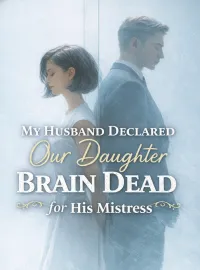
My Husband Declared Our Daughter Brain Dead for His Mistress
My Husband Declared Our Daughter Brain Dead for His Mistress Summary
Chapter 1 of My Husband Declared Our Daughter Brain Dead for His Mistress
The world narrowed to a single sound: the wail of the ambulance siren. It cut through Portland's afternoon traffic like a blade, and I ran alongside the gurney, my hand clamped around Lily's cold fingers, my heart hammering so hard I thought my ribs might crack. The paramedics kept saying things I couldn't process—words like 'GCS 7' and 'deceleration injury'—but all I could see was my daughter's face, pale as the hospital sheets, her dark lashes still against her cheeks.
My phone had been buzzing incessantly since the school called. Sullivan's name flashed on the screen, but I couldn't answer. My voice had abandoned me the moment I'd seen Lily lying on the sidewalk outside her preschool, a small crowd gathered like a dark halo around her still form. The driver had fled. No one had seen the license plate. Just a blur of red taillights disappearing around the corner.
'Lenora.' A nurse's voice cut through my panic. 'We need you to stay here while the doctors examine her.' She gestured to a plastic chair in the waiting area, but I shook my head violently.
'I need to be with her,' I said, my voice scraping raw. 'I need to hold her hand.'
The nurse—her badge said 'Sarah'—looked at me with the kind of practiced sympathy that made my stomach twist. 'The doctors need space to work. You can see her once they've stabilized her.'
I wanted to scream, to push past her, to demand my rights as Lily's mother. But my legs felt rooted to the floor, and my hands were shaking so badly I had to clench them into fists. Sarah guided me to the chair and pressed a paper cup of water into my hands.
'How long?' I asked, staring at the water.
'We don't know yet,' she said, and I could hear the careful neutrality in her voice. 'The next few hours are critical.'
The waiting area was a sterile purgatory of beige walls and the distant hum of machinery. Other families huddled in their own private crises—a woman sobbing into her husband's shoulder, an elderly man staring at his phone with hollow eyes. I felt like a ghost among them, disconnected from their grief by the sheer magnitude of my own fear.
My phone buzzed again. Sullivan. I answered this time, my voice barely a whisper.
'Lily's been hurt,' I said. 'Hit-and-run. We're at Portland General.'
There was a beat of silence, then his voice, sharp with authority. 'I'm on my way. What room?'
'I don't know yet. They took her for scans.' I pressed my free hand against my mouth, trying to hold back the sob that threatened to escape. 'Sullivan, she's so pale. She won't wake up.'
'Just breathe, Nora,' he said, using the nickname I'd never liked. 'I'll be there in ten minutes.'
But it was twenty minutes before he burst through the ER doors, his suit jacket flapping, his face tight with the kind of controlled panic I'd only seen when his business deals went south. He scanned the room, spotted me, and crossed the distance in long strides.
'What happened?' he demanded, not of me, but of the nurse who materialized beside us. Sarah explained the situation in clipped, professional terms while Sullivan nodded, his jaw clenched.
Then the doors to the treatment area swung open, and Dr. Kessler emerged. I recognized him from previous visits—Lily's checkups, her mild asthma diagnosis. Today, his face wore a grave expression that made my blood run cold.
'Mr. and Mrs. Elliott,' he said, his voice smooth and practiced. 'I need to speak with you about Lily's condition.'
We followed him into a small consultation room. The fluorescent lights hummed overhead, casting everything in a harsh, clinical glow. Dr. Kessler closed the door behind us and turned to face us, his hands clasped in front of him.
'I'm afraid the news is not good,' he began, and the world tilted beneath my feet.
The scans were displayed on a monitor behind him—gray and white images that meant nothing to me but clearly told a story to him. He pointed to dark areas, explained terms like 'diffuse axonal injury' and 'midline shift,' but all I could focus on was the way his eyes wouldn't quite meet mine.
'Based on these findings,' he said, his voice taking on a finality that made my skin crawl, 'I'm afraid Lily has suffered catastrophic, irreversible brain damage. There is no viable recovery pathway.'
The words hit me like physical blows. I staggered back, my hand finding the wall for support. 'No,' I whispered. 'That can't be right. She squeezed my hand earlier. I felt it.'
Dr. Kessler's expression softened into something almost pitying. 'What you felt was a simple reflex, Mrs. Elliott. A response from the spinal cord, not the brain. I understand this is difficult to accept, but the neurological damage is extensive and beyond repair.'
I opened my mouth to argue, to tell him he was wrong, that my daughter—my bright, beautiful girl—couldn't possibly be gone when she was right there, just beyond those doors, waiting for me to save her. But the words died in my throat as I looked at Sullivan's face.
He was staring at the scans with an expression I'd never seen before—a terrible, hollow acceptance that chilled me to the bone.
You may also like












Popular on MiniShort