

Consider for a moment what it costs a story to put its heroine in a disguise. The genre has a long tradition of it — from Shakespeare to Mulan to a dozen shojo manga — and the reason it keeps working is not the costume. It's the surveillance. Every scene becomes a test. Every glance from the wrong person is a potential unraveling. When the Moon Hides Crown understands this instinctively, and it builds its entire dramatic architecture around the unbearable weight of being almost seen.
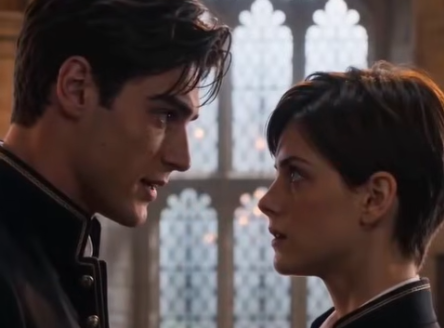
The premise slots neatly into the paranormal romance lane: Seraphina, daughter of an Alpha, faces an arranged marriage to an Alpha King she has no desire to know. Rather than accept a life scripted by others, she vanishes the night before her wedding and re-enters the world in borrowed form — male-presenting, identity concealed — to enroll in an all-male werewolf academy. The stated goal is to prove herself. The real goal, the one the story earns, is something closer to the right to exist on her own terms.
What makes When the Moon Hides Crown more structurally interesting than its premise suggests is the way the academy setting functions as a pressure cooker rather than a backdrop. This isn't a school drama with supernatural window dressing. The all-male werewolf environment means Seraphina isn't just hiding — she's hiding inside a species that can smell fear, detect heartbeats, and sense emotional shifts. Every romantic flutter, every moment of stress, every reaction she has to Ronan becomes a physiological event that her classmates are biologically equipped to notice. The disguise isn't thin because she's careless. It's thin because the world she's entered was never designed to contain a secret like hers.
That's where the tension machine runs. Each episode tightens the vice: the longer she stays, the deeper her relationships become; the deeper her relationships, the harder the fall when the truth surfaces. This is not a drama that forgets its own rules.
From a psychological angle, Seraphina is a character operating under a fundamental misread of her own situation. She frames her disguise as a proof-of-concept — a mission to demonstrate her worth in a world that has denied her access. But the story quietly, persistently complicates that framing. She isn't just proving herself to the academy.
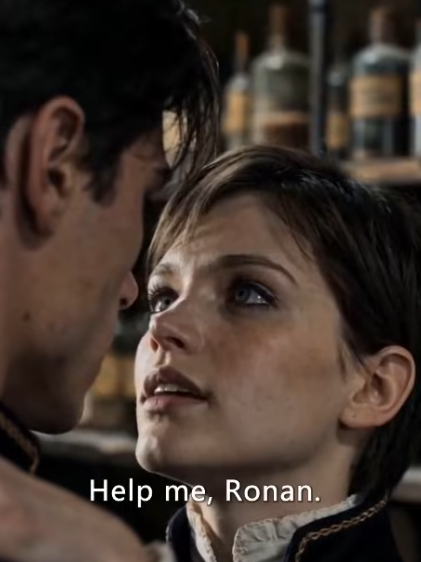
She's proving something to herself: that she can survive without the protections and limits that came with her birth identity. The arranged marriage wasn't only a cage. It was also a safety net. By escaping it, she hasn't just gained freedom; she's entered genuine danger without a floor beneath her.
Reader and viewer responses note that Seraphina is compelling precisely because she's fighting for power, identity, and freedom in a world that keeps trying to limit her — but the drama's emotional intelligence lies in never letting that fight look clean. Freedom here has a cost, and it's paid in sustained anxiety.
If Seraphina is the story's heart, Ronan is its pressure point. His role, from a structural standpoint, is precise: he is the character who should not be interested, positioned closest to the truth, yet choosing — consciously or otherwise — to not quite reach for it. His "keen interest" in the disguised Seraphina is the drama's central irony machine. The audience watches him notice things, watches him linger, watches him process information that should, by any logical calculus, lead him somewhere he hasn't yet arrived.
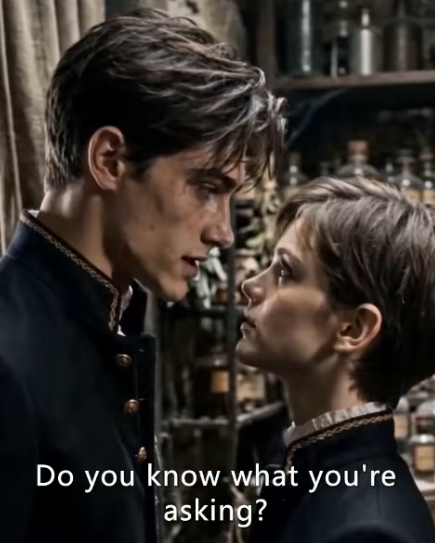
The detail that Ronan himself harbors secrets is the drama's smartest structural move. It creates symmetry. Two people with something to hide, drawn toward each other with a gravity neither fully understands. The question the drama asks — and pointedly does not answer early — is whether their secrets are compatible, or catastrophically opposed.
DramaWave's own promotional framing for this title — "One girl. A school of hungry wolves. The most dangerous game is about to begin" — signals exactly what kind of emotional register it's pitching for: sustained threat, sustained desire, the two overlapping uncomfortably. This is not a drama interested in giving its characters breathing room. The slow burn isn't a pacing problem; it's the point.
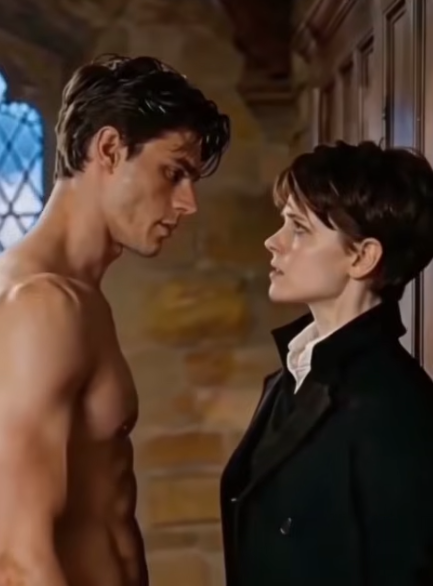
The romantic tension between Seraphina and Ronan operates in the grammar of withheld information. What the characters don't say to each other, what they choose not to confront, is where the feeling lives. For viewers who find this kind of restrained emotional architecture satisfying, When the Moon Hides Crown delivers its payoff through accumulation rather than climax. Each small scene adds weight to a structure that the story is in no hurry to resolve.
When the Moon Hides Crown will frustrate viewers looking for immediate emotional release. It rewards patience and an appetite for dramatic irony — for the particular pleasure of knowing what the characters don't, and watching that gap close at its own pace. The werewolf academy setting gives it a genre coat, but at its core this is a story about the psychological labor of maintaining a false self while forming real connections. That labor is rendered with enough care that the disguise never feels like a gimmick. It feels like the only move Seraphina had — and the most dangerous one she could have made.
For the short drama format, it's notable that When the Moon Hides Crown doesn't use its compressed runtime as an excuse to skip the interiority. The emotional stakes feel lived-in, not summarized.
Where to Watch:When the Moon Hides Crown is available on DramaWave — streaming via the DramaWave app and on YouTube. Full episodes and a playlist of complete parts can be found at DramaWave. Episodes are also indexed on YouTube for free viewing.
Q1: What is When the Moon Hides Crown about, and where can I watch full episodes?
A: When the Moon Hides Crown follows Seraphina, an Alpha's daughter who disguises herself as a male student to attend an all-male werewolf academy and escape an arranged marriage. She develops feelings for a mysterious classmate named Ronan — while both of them conceal secrets that could upend everything. Full episodes are available on DramaWave via YouTube and the DramaWave app.
Q2: Is When the Moon Hides Crown a movie or a drama series?
A: It's a 2026 short drama series produced in the AI drama format, distributed primarily through DramaWave. It's been collected and released in full-episode and full-movie compilations across YouTube and Dailymotion, so viewers can watch it as an episodic series or as a continuous film-length compilation.
Q3: Who are the main characters in When the Moon Hides Crown?
A: The two central characters are Seraphina, the Alpha's daughter who goes undercover disguised as a man, and Ronan, the mysterious male student who becomes intensely interested in her despite — or because of — what he may sense beneath the surface. No confirmed cast names from credited actors are publicly available at this time.
Q4: Is When the Moon Hides Crown free to watch on DramaWave?
A: Full episodes are accessible on DramaWave's YouTube channel at no cost. The DramaWave app may offer additional episodes or premium access — check the DramaWave app for current availability and any subscription options in your region.
Q5: What makes When the Moon Hides Crown different from other werewolf romance dramas?
A: The drama's most distinctive quality is its structural use of double concealment: Seraphina is hiding her identity inside an environment — a werewolf academy — where the inhabitants are biologically attuned to detect deception. That isn't set dressing; it's what makes every interaction tense. Add to that a male lead whose own secrets create genuine narrative symmetry, and the result is a disguise romance that builds its tension from the inside out rather than relying on external obstacles alone.