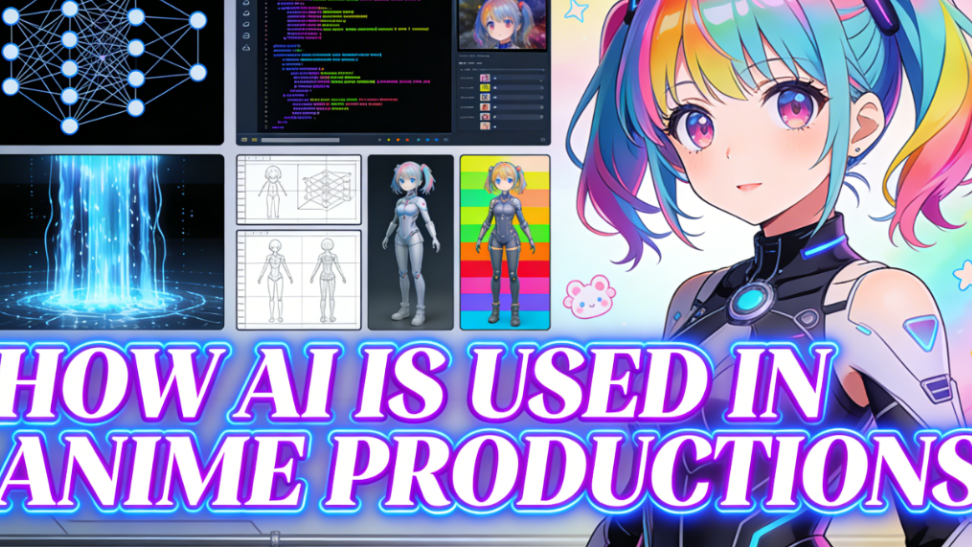
AI isn’t just a theme inside anime anymore—it’s quietly reshaping how anime and short dramas are actually made. If you enjoy AI anime, system-driven stories, or fast-paced short dramas, understanding how AI is used in production can deepen how you watch and appreciate these shows.
This guide breaks down where AI appears behind the scenes, what changes viewers may notice, and why AI-assisted production matters for the future of anime storytelling—without technical jargon or spoilers.
For fans, “AI anime” usually refers to two different things:
● Story AI – artificial intelligence as part of the plot (systems, androids, omniscient laws).
● Production AI – real-world AI tools used to speed up animation, enhance visuals, or assist creators.
This article focuses on production AI, because it directly affects how often new short dramas release, how they look, and how much studios can experiment.
AI-assisted frame interpolation helps generate in-between frames from key animation. This doesn’t replace animators, but it reduces repetitive workload—especially in action-heavy or dialogue-light scenes.
What viewers notice: smoother motion in non-critical scenes.
AI tools can assist with flat coloring, line smoothing, and error correction. Artists still handle key visuals and emotional scenes, while AI speeds up mechanical tasks.
What viewers notice: cleaner visuals, fewer inconsistencies episode to episode.
For short dramas and web anime, AI-generated drafts can help teams test background ideas quickly. Human artists refine the final look.
What viewers notice: more ambitious settings even in low-episode-count series.
Older anime and short series are being upgraded to HD or 4K using AI upscaling instead of full redraws.
What viewers notice: classic shows looking sharper on modern screens.
AI tools can map voice performances to facial animation, especially for 3D or hybrid anime projects.
What viewers notice: better lip-sync and expressive faces in 3D short dramas.
Short dramas benefit the most from AI-assisted production because:
● Faster release cycles → more frequent updates
● Lower costs → higher visual quality on small budgets
● Creative freedom → studios can test bold ideas without massive risk
This is why many system-based, cultivation-style, and AI-themed dramas are appearing in short or web formats first.
Not necessarily—but it depends on how it’s used.
When AI handles background or repetitive tasks, animators can focus more on:
● emotional acting
● key fight moments
● character-defining scenes
Problems arise only when studios overuse AI without artistic oversight, which can result in visuals that feel generic or soulless. Most well-received projects today use AI as support, not a replacement.
You might be seeing AI-assisted production if you notice:
● extremely clean backgrounds in minor scenes
● smooth but slightly uniform crowd movement
● older anime suddenly released in high resolution
● fast release schedules with consistent quality
These aren’t negatives—they’re signs of modern production pipelines at work.
Anime has always relied on:
● limited animation
● symbolic motion
● smart shortcuts
AI fits naturally into this tradition. It enhances efficiency without changing what anime fundamentally is: human stories driven by emotion, conflict, and imagination.
AI is already part of how your favorite anime and short dramas are made—even if you never see it on screen. For fans, this means:
● more content
● better visuals
● faster experimentation
As long as creators stay in control, AI doesn’t weaken anime—it helps it evolve.
If you love system-driven stories, AI-themed worlds, or fast-paced short dramas, you’re watching the genre grow in real time.