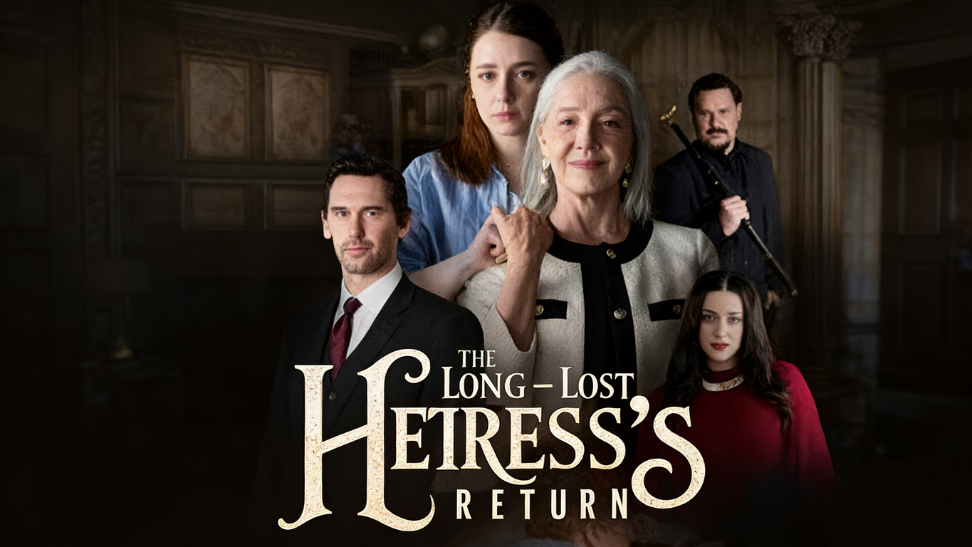
What makes The Long-Lost Heiress's Return different from a standard heiress drama is the engine driving it: not the daughter's ambition, but the mother's fury. Nova Parker (Casey Schryer) is found years after a tragic accident separated her from her family — not triumphant, not hidden in luxury, but exploited in a medical lab by opportunists who never knew who she was. When her mother Zoe Parker (Thresa Richardson), who built a business empire specifically to fund the search for Nova, finally gets that call — the reunion she has waited years for arrives already stained by what was done to her daughter.
Quick verdict: A mother-daughter reunion drama that flips the genre's usual dynamic — here, it's the mother who becomes the weapon. Thresa Richardson's Zoe is the reason to watch.
| Title | The Long-Lost Heiress's Return |
| Platform | MiniShort / ReelShort |
| Year | 2025 |
| IMDb Rating | 5.9 / 10 |
| Genre | Drama, Family |
| Lead Cast | Casey Schryer (Nova Parker), Thresa Richardson (Zoe Parker) |
| Supporting Cast | Dylan Vox (Luke), Joey Heyworth (Owen), Noah Blake (Jonathan), Dilara Foscht (Mistress Helen), Maura Lefevre (Ruby) |
Most heiress dramas begin with the reveal. The Long-Lost Heiress's Return begins with the aftermath of concealment — and with the cost of it. Nova Parker wasn't hiding her identity by choice or strategy. A tragic accident separated her from her family years ago, and the people who found her afterward treated her not as a person with a history but as a resource. By the time Zoe Parker tracks Nova to a medical lab, her daughter has been degraded and exploited by a network of opportunists who had no idea — and would not have cared — that she was the heir to a business empire.
That setup inverts the standard genre expectation. In most short dramas of this type, the lost heiress is the active force: she hides, she endures, she reclaims. Here, Nova is largely the subject of the story's early acts rather than its protagonist. What she has suffered is the wound. Zoe is the immune response. The series is fundamentally about what a mother becomes when she learns that the years she spent building power and searching for her daughter were years her daughter spent being used.
Core tension: Every scene of Nova's exploitation lands differently once the audience understands that her mother has been looking for her the entire time — and that a reckoning is now in motion.
Thresa Richardson carries the dramatic weight of the series as Zoe Parker. The role requires something specific: grief and rage held at the same time, neither one overwhelming the other. Zoe is not a woman who collapses when she finds Nova. She assesses. She calculates. The empire she built was always a means to an end — finding her daughter — and now it becomes a weapon. Richardson plays Zoe's transition from grieving mother to deliberate force without softening either state. The love is still there, visible in every scene with Nova. So is the fury, directed outward at the people who profited from her daughter's vulnerability.
What makes Richardson's performance particularly effective is the restraint. Zoe's power in the series does not come from emotional explosion — it comes from the controlled deployment of everything she has built. She knows exactly what she has and exactly how to use it. That stillness, undercut by the heat of what she knows, is the performance's most compelling quality.
Casey Schryer plays Nova in the difficult position that the story's structure creates: she is the reason for everything, but the early episodes belong to Zoe's reaction rather than Nova's agency. Schryer handles this by playing Nova's survival not as passivity but as endurance — there is a stubbornness to her, a refusal to be entirely consumed by her circumstances, that makes her a sympathetic and grounded presence even in scenes where she has limited control over what is happening to her.
As the series develops and the reunion with Zoe stabilizes Nova's position, Schryer has more room to show what Nova is capable of as an active character rather than a reactive one. The chemistry between Schryer and Richardson as mother and daughter is the series' emotional backbone, and it holds.
Dylan Vox plays Luke, one of the opportunists who benefited from Nova's situation. Joey Heyworth plays Owen. Dilara Foscht plays Mistress Helen. The series populates Nova's exploitative world with a specific cast of antagonists rather than leaving them as a faceless group, which is the right structural decision — it gives Zoe's eventual reckoning specific targets rather than abstract enemies, and it makes the accounting personal rather than systemic.
Luke, in particular, represents the series' most direct target: someone who looked at Nova and saw an opportunity rather than a person. Vox plays him with a confidence that is grounded in the assumption he will never face consequences — which is precisely the quality that makes his scenes with Zoe, once she arrives, dramatically satisfying.
The decision to make Zoe, not Nova, the series' primary active force is The Long-Lost Heiress's Return's most interesting structural choice. Heiress dramas typically center on the lost daughter's return and her own reclamation of identity and power. By shifting that agency to the mother — by making Zoe the one who holds power, directs resources, and executes the reckoning — the series creates a different kind of emotional register. This is not a story about a young woman finding herself. It is a story about what a mother's love looks like when it has had years to calcify into something harder and more dangerous.
That reframing also raises the emotional stakes of the reunion itself. When Zoe finally reaches Nova, the audience is not watching a discovery scene — they are watching two people who have each been surviving separately, finally in the same room. The reunion is not a resolution. It is the beginning of what Zoe intends to do next.
Placing Nova in a medical lab, exploited by people with no knowledge of who she is, is a more dramatically specific setup than the standard 'heiress works as maid' formula. The medical context implies a particular kind of vulnerability — physical, systematic, documented — that makes the wrongdoing more concrete and the eventual accountability more necessary.
It also creates a specific dramatic irony: the people who exploited Nova were not targeting her because of what she was. They targeted her because, in their eyes, she was nobody. That is the irony the series leverages. The woman whose daughter they degraded has built an empire. The nobody they exploited is an heiress. And the reckoning coming their way is proportional to the scale of what they chose not to see.
• Thresa Richardson's Zoe is a standout maternal protagonist in the short drama genre — controlled, purposeful, and genuinely formidable
• The structural inversion — mother as active force, daughter as the wound that motivates her — creates a distinct emotional register
• The antagonist cast is populated with named, specific characters rather than faceless villains, making the reckoning feel personal
• The premise avoids the 'hidden identity by choice' formula, giving Nova's situation a more serious dramatic weight
• The IMDb rating of 5.9 reflects early viewer feedback — the series is not universally praised, and viewers who prefer a more active female lead protagonist may find Nova's early passivity frustrating
• The pacing in the opening episodes is weighted toward setup; the payoff builds across the series rather than arriving quickly
• Viewers expecting the standard 'heiress reclaims power herself' arc will find the mother-driven structure a significant tonal departure
The Long-Lost Heiress's Return earns its recommendation on the strength of one thing: Thresa Richardson's portrayal of a mother whose search has ended and whose reckoning is just beginning. The series does not offer the most technically polished execution in MiniShort's catalog — its IMDb score of 5.9 reflects that honestly — but the dramatic premise is genuinely affecting, and the mother-centered structure sets it apart from most entries in the heiress genre.
For viewers who want something with more emotional specificity than a standard 'heiress reclaims power' drama, and who are drawn to the particular devastation of a parent arriving too late to prevent harm but not too late to demand accountability, The Long-Lost Heiress's Return is worth the watch.
Watch More: